Bwindi vs Volcanoes National Park: Which Gorilla Trekking Destination Is Right for You?
Gorilla trekking is a bucket-list adventure in Africa, offering an unforgettable, humbling encounter with one of our closest relatives in the wild. You've decided to trek with mountain gorillas. Now comes the question that stumps nearly every traveler planning this trip:
Do you go to Bwindi Impenetrable National Park in Uganda or to Volcanoes National Park in Rwanda?
Both parks shelter some of the world's last remaining mountain gorillas, and both will give you one of the most profoundly moving wildlife encounters of your life. But they are not the same experience — not even close. The terrain is different. Costs are different. The parks also vary in atmosphere, trekking experience, add-ons, and the kinds of travelers who thrive in each one.
This guide breaks it all down: permit prices (including resident and East African rates most comparisons skip), gorilla families, trekking difficulty, getting there, accommodation, the best time to visit, fitness considerations, total trip cost estimates, and what to do before and after your trek. By the end, you'll know exactly which park suits your travel style, budget, and expectations — and how to book your spot with African Safari Trips before it sells out. Our team has arranged treks into both destinations for all kinds of travellers, including first-timers and senior travellers.
What Makes Gorilla Trekking So Special?
Mountain gorillas share approximately 98% of their DNA with humans. Fewer than 1,100 remain in the wild, found only in two places on Earth: the Virunga Massif (the volcanic mountain chain spanning Uganda, Rwanda, and the Democratic Republic of Congo) and Uganda's Bwindi Impenetrable Forest. You cannot see a mountain gorilla in a zoo. The only way to encounter one is to enter their forest.
When you do, it is quite unforgettable! Locking eyes with a silverback with calm, intelligent, yet unmistakably dominant eyes is unlike anything else on Earth. The hour you spend with a gorilla family passes in what feels like minutes but stays with you for a lifetime.
There are two premier destinations for gorilla trekking: Bwindi Impenetrable Forest National Park in southwestern Uganda, and Volcanoes National Park in northwestern Rwanda.
Bwindi Impenetrable Forest National Park, Uganda
Landscape and Atmosphere
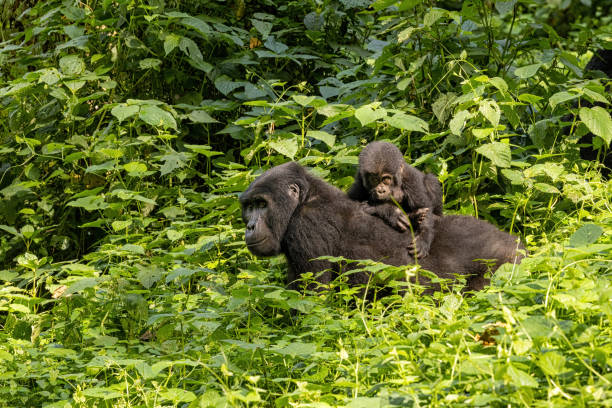
Bwindi earns its name. This ancient forest, over 25,000 years old, is dense, layered, and alive in a way that's difficult to put into words. Thick canopy shuts out much of the sky. Vines tangle across the trail. Mist clings to the ridges in the early morning, making trekking through the forest feel like pushing into a genuinely wild, untouched place. That rawness is exactly what draws many travelers here.
The park covers 331 square kilometres and is a UNESCO World Heritage Site. It's home to over 20 habituated gorilla families — the largest concentration of habituated mountain gorillas anywhere in the world, alongside 11 other primate species, over 350 bird species, and over 120 mammal species, making it one of Africa's most biodiverse ecosystems.
The Four Trekking Sectors
One of Bwindi's biggest advantages over Volcanoes is choice. The park is divided into four distinct trekking sectors, each offering a different experience:
Buhoma (North) — The park's original gorilla trekking sector and the most established, home to Park Headquarters. Trails here are comparatively gentler, infrastructure is well-developed, and there's a strong selection of midrange and luxury lodges. Ideal for first-time trekkers or anyone who wants a classic Bwindi experience without the most demanding hikes.
Rushaga (South) — Renowned for sheltering the highest number of habituated gorilla families in the park, including families available for the Gorilla Habituation Experience. Rushaga is accessible from the Rwandan border via Kisoro, making it well-suited for travelers combining Uganda and Rwanda on a single trip.
Ruhija (East) — The highest and coldest sector in Bwindi, sitting above 2,300 metres. Ruhija is the most remote sector and sees the fewest tourists. Treks here can be long and demanding, but the sense of solitude is unmatched — ideal for experienced hikers seeking a truly off-the-beaten-path encounter.
Nkuringo (Southwest) — Dramatic, ridge-top terrain with sweeping views over the Virunga Volcanoes into Rwanda and Congo. Treks from Nkuringo are among the most physically demanding in the park, featuring a steep descent into and out of the gorge, but the scenery is extraordinary.
Choosing the right sector is one of the most important decisions in planning a Bwindi gorilla trek — something we help you get right based on your fitness level and interests. Average trek duration is 2–6 hours, sometimes extending to 8+ hours, depending on the sector, weather, and daily gorilla movements.
Gorilla Families in Bwindi
Bwindi's gorilla families each have a distinct personality and history. Notable groups include:
- Mubare Group (Buhoma) — The oldest habituated family, first opened to tourists in 1993, currently led by silverback Kanyonyi.
- Nshongi Group (Rushaga) — Once the largest habituated group ever recorded, with 36 members.
- Rushegura Group (Buhoma) — Remarkably calm and accessible; this group famously "self-habituated" by wandering through lodges and community gardens near Buhoma.
- Kahungye Group (Rushaga) — A larger family known for dramatic silverback interactions, popular with photographers.
- Bweza Group (Rushaga) — A Nshongi splinter group, generally easier to reach and well-suited to less experienced trekkers.
- Mishaya Group (Rushaga) — Founded when silverback Mishaya broke from Nshongi in 2010; now led by silverback Kasigazi.
- Bitukura Group (Ruhija) — Relaxed and approachable; a good entry point for the remote Ruhija sector.
- Oruzogo Group (Ruhija) — Found at higher elevations, known for atmospheric, mist-shrouded encounters.
- Nkuringo Group (Nkuringo) — The sector's founding family (2004), reached via the famous steep gorge descent.
- Christmas Group (Nkuringo) — Named for when it was first recorded; one of the more adventurous treks in the southwest.
Gorilla family allocation is done by park management on the morning of your trek, based on group fitness levels and family location that day.
The Gorilla Habituation Experience in Bwindi
One experience unique to Bwindi is the Gorilla Habituation Experience. Unlike a standard trek, where you spend one hour with a fully habituated family, the habituation experience places you with a gorilla family still in the process of becoming accustomed to human presence. You spend up to four hours with the family, accompanying researchers and rangers as they work — as close as it gets to a genuine field research experience. It's limited to just four participants per group, across two dedicated families in the Rushaga sector (so only eight habituation permits are issued per day, park-wide).
The permit currently costs $1,500 per person for foreign non-residents. The Uganda Wildlife Authority has confirmed this will rise to $1,800 from 1 January 2027, so booking before the end of 2026 locks in the current rate. It requires a higher fitness level and genuine interest in spending extended time in the forest, but for those who qualify, it's the most immersive gorilla experience available anywhere in the world.
Getting to Bwindi
By Road: From Entebbe or Kampala, Bwindi is an 8–10 hour drive, a long but scenic route through Uganda's southwest highlands. Many travelers break the journey with a night in Mbarara or at Lake Mburo National Park.
The most recommended alternative is to start or end your Bwindi trek from Kigali, Rwanda. The drive from Kigali to the Rushaga or Nkuringo sectors is just 3–4 hours, making Bwindi highly accessible for those flying into Rwanda and opening up a natural Uganda–Rwanda safari combination.
By Air: Domestic charter flights from Entebbe to Kihihi (for Buhoma) or Kisoro (for Rushaga and Nkuringo) reduce travel time to under an hour from the airstrip to the park.
Volcanoes National Park, Rwanda
Landscape and Atmosphere
Volcanoes National Park sits within the Virunga Massif in northwestern Rwanda, defined by the dramatic silhouettes of five of the eight Virunga volcanoes: Karisimbi, Bisoke, Muhabura, Gahinga, and Sabyinyo. The scenery here is striking in a completely different way from Bwindi. The park's vegetation — bamboo forest, open grassland, and alpine moorland on the upper slopes — is more open, allowing longer sightlines and clearer photographs.
Also known as Parc National des Volcans, Volcanoes was made famous by Dian Fossey, the primatologist whose research camp at Karisoke put mountain gorillas on the global conservation map. That legacy is felt throughout the visitor experience today.
Volcanoes covers approximately 160 square kilometres and hosts 12 habituated gorilla families, all of which begin their treks from the same starting point: Kinigi Park Headquarters.
The Gorilla Trekking Experience
Gorilla trekking in Volcanoes is generally considered less physically demanding than in Bwindi. Trails are better defined, vegetation is less dense, and many gorilla families live at lower altitudes within the bamboo zone. Average trek duration is 1.5–4 hours.
That said, altitude is a genuine factor. The park ranges from 2,500 to over 4,500 metres above sea level. Some families, notably the Susa Group, are found high on Mount Karisimbi, involving long, steep hikes at altitude. Travelers prone to altitude sickness should factor this in and consider a night in Kigali to acclimatize first.
All treks depart from Kinigi at around 7:30 am following a ranger briefing. The single starting point makes logistics simple but also means there's less variety in the trekking experience from day to day compared with Bwindi's four sectors.
Gorilla Families in Volcanoes
Rwanda's gorilla families are among the most studied in the world, and several have become famous in their own right:
- Susa Group — Dian Fossey's original research group, famous for having twins. Located high on Karisimbi, one of the most challenging treks in the park.
- Sabyinyo Group — Famous for being the most accessible, frequently found on lower slopes, making this one of the easier treks.
- Kwitonda Group — A group of over 18 members that migrated from the DRC, led by silverback Kwitonda ("humble one").
- Agashya Group — Formerly known as Group 13, known for rapid growth in numbers.
- Bwenge Group — Featured in the film Gorillas in the Mist, often found on the Karisoke slopes.
As in Uganda, gorilla family allocation is done by park management at the morning briefing.
Getting to Volcanoes
This is one of Rwanda's most compelling selling points. Volcanoes National Park is just 2.5–3 hours from Kigali International Airport on good tarmac roads. You can fly in the morning, check in, and be ready to trek the next day. No other gorilla destination is this accessible.
Volcanoes is ideal for time-constrained travelers who want to fit a gorilla trek into a broader East Africa itinerary, or for a short trip from Europe or North America.
Bwindi vs Volcanoes: Head-to-Head Comparison
|
Particulars
|
Bwindi (Uganda)
|
Volcanoes (Rwanda)
|
|
Standard Permit (foreign non-resident)
|
$800
|
$1,500
|
|
Standard Permit (foreign resident)
|
$700
|
$500
|
|
Standard Permit (East African citizen)
|
UGX 300,000
|
$200
|
|
Habituation Experience
|
$1,500 (rising to $1,800 from 1 Jan 2027)
|
Not available
|
|
Gorilla Families
|
20+ habituated groups
|
12 habituated groups
|
|
Daily Permits Available
|
~160 across the park
|
96 across the park
|
|
Trekking Terrain
|
Dense jungle, steep, unpredictable
|
More open, clearer trails
|
|
Trek Duration
|
2–8 hours
|
1.5–4 hours
|
|
Trekking Sectors
|
4 (Buhoma, Rushaga, Ruhija, Nkuringo)
|
1 (all from Kinigi)
|
|
Time With Gorillas
|
1 hr standard trek; 4 hrs habituation experience
|
1 hour
|
|
Accommodation Range
|
Budget to ultra-luxury
|
Midrange to ultra-luxury
|
|
Distance from Capital's Airport
|
8–10 hrs from Entebbe; 3–4 hrs from Kigali
|
2.5–3 hrs from Kigali
|
|
Best For
|
Adventurers who value longer safaris and value for money
|
Luxury, short trips, easy logistics
|
Gorilla Trekking Permit Costs 2026/2027
The permit is only one part of what your gorilla trek actually costs. Here's a realistic breakdown of the total investment for each destination:
Uganda (Bwindi) — Estimated Total per Person
- Gorilla trekking permit: $800
- Accommodation per night: $150–$600 depending on budget vs. luxury
- Return flights (international + domestic charter, if applicable): $200–$1000
- Ground transfers (Kigali–Bwindi or Entebbe–Bwindi): $100–$300)
- Porter (recommended): $15–$20
- Meals and incidentals: $50–$100/day
Rwanda (Volcanoes) — Estimated Total per Person
- Gorilla trekking permit: $1,500
- Accommodation per night: $300–$2,000 (mostly luxury)
- Transfers from Kigali: $80–$150
- Porter (optional): $15–$20
- Meals and incidentals: $60–$150/day
Planning Tip: For budget-conscious travelers, Uganda delivers a more accessible price point — a Bwindi permit costs roughly half of a Volcanoes permit, and accommodation options run cheaper too. For those prioritizing convenience and luxury from arrival to departure, Rwanda's premium is easy to justify.
Fitness, Age, and Accessibility
Bwindi demands a decent level of fitness. Its steep, muddy, and sometimes overgrown trails can make treks unpredictable — average duration is 2–6 hours, sometimes stretching past 8. Serious mobility issues can be challenging, though porter-assisted carry chairs are available in some sectors. Rangers do their best to match groups to suitable gorilla families, and age is rarely a barrier if you're reasonably fit — many trekkers in their 60s and 70s succeed regularly.
Volcanoes, on the other hand, is generally more manageable for moderate fitness levels thanks to clearer trails and shorter average treks. Altitude (up to 4,500m) is the main hurdle, so consider acclimatizing in Kigali if you're prone to altitude sickness. The high Susa trek on Mount Karisimbi is particularly demanding.
Both parks set a minimum age of 15 to trek mountain gorillas and conduct health checks at the briefing. Travellers showing any signs of illness (especially respiratory) will be prohibited from trekking. Gorillas share 98% of our DNA and are highly vulnerable to human diseases.
Photography in Both Parks
Volcanoes generally offer better light and visibility for photography. The open bamboo forests allow more natural light to reach the gorillas, and the volcanic backdrops create stunning context for wide shots. The shorter, more predictable trek also means you arrive with more energy for photography.
Bwindi is more atmospheric but more challenging photographically. The dense canopy limits light, and conditions underfoot mean you may not always be in the ideal position — but the raw jungle setting produces deeply evocative images.
Pro Tip: Both parks prohibit flash photography. Carry a camera with strong low-light capability and a 70–200mm lens.
Beyond Mountain Gorillas: Other Things to Do
Bwindi (Uganda)
- Batwa Cultural Trail — A moving guided experience with the indigenous Batwa people, sharing traditional forest knowledge, hunting skills, and medicinal plants.
- Birding & Nature Walks — World-class birdwatching with over 350 species, including 23 Albertine Rift endemics.
- Forest Hiking & Exploration — Guided hikes offering chances to spot monkeys, butterflies, and the park's rich biodiversity.
- Chimpanzee Trekking in Kibale Forest — Africa's premier chimpanzee trekking destination, a few hours' drive away.
- Game Drives & Boat Safaris in nearby Queen Elizabeth National Park — Famous for tree-climbing lions, hippos, and the Kazinga Channel.
- Relaxation at Lake Bunyonyi — One of Africa's most picturesque lakes, perfect for a rest day.
Volcanoes (Rwanda)
- Golden Monkey Trekking — Unique to the Virungas; playful, endangered monkeys in bamboo forests, often combined with gorilla trekking.
- Dian Fossey Hike — A 3–4 hour trek to the researcher's original Karisoke campsite and grave on the slopes of Mount Karisimbi.
- Volcano Hikes & Nature Walks — Climb peaks like Bisoke or explore alpine meadows and bamboo zones.
- Wildlife Safaris in Akagera National Park — Rwanda's Big Five savannah park with a remarkable rewilding success story.
- Explore Nyungwe Forest — Ancient rainforest featuring chimpanzee tracking, colobus monkeys, and a thrilling canopy walkway.
Best Time to Go: Month-by-Month
Gorilla trekking runs year-round in both parks, but conditions vary:
June–September (Long Dry Season) — Best conditions in both parks. Trails are firmer, visibility is good, and weather is generally clear. This is peak season, and permits sell out fastest. Book 3–6 months in advance.
December–February (Short Dry Season) — An excellent alternative to peak season, with good trekking conditions and slightly fewer tourists. Permits are more available, though booking ahead is still advised.
March–May (Long Rains) — Trails become muddy and challenging, especially in Bwindi. But the forests are lush and green, lodges are quieter, and significant discounts are available on permits and accommodation. Uganda offers discounted low-season permit rates during this window; for experienced trekkers on a budget, this period is worth considering.
October–November (Short Rains) — Similar to the long rains, with shorter and less predictable rainfall. November is a low-season month in Uganda with fewer crowds. Treks are still entirely possible and rewarding.
Gorilla Conservation Impact
Every permit you purchase directly funds mountain gorilla conservation.
In Uganda, the Uganda Wildlife Authority (UWA) shares 20% of annual park revenue with communities surrounding the park, and $10 from every gorilla permit goes directly to community projects.
In Rwanda, 10% of all national park revenue flows back to local communities through the Revenue Sharing Programme.
This funding has built schools, health clinics, and community infrastructure around both parks. It has also given local communities a direct financial stake in protecting the gorillas, transforming potential poachers into some of the gorillas' most committed guardians. When you book a gorilla trek, you're not just having an experience — you're also participating in one of the most successful conservation stories in modern wildlife history.
Mountain gorilla numbers have grown from approximately 620 in 2008 to over 1,100 today, making them one of the only great apes whose population is increasing. Your permit is part of the reason why.
Which Park Should You Choose?
Choose Bwindi if:
- Budget is a consideration ($800 vs. $1,500 permit)
- You want the most immersive, raw jungle experience
- You have time for a longer trip and want to combine gorillas with Uganda's other parks
- You want the Gorilla Habituation Experience (unique to Uganda)
- You're a reasonably fit traveler who enjoys a physical challenge
Choose Volcanoes if:
- You have limited time and want a smooth, short trip
- You're flying into Kigali and want minimal travel logistics
- Luxury accommodation and seamless service are a priority
- You prefer a more structured, accessible trekking experience
- You want to combine gorilla trekking with Rwanda's other parks (Akagera, Nyungwe)
Considering both? Opt for Bwindi and Volcanoes together if you have 7+ days, want the full contrast of the two forests, desire two gorilla encounters in one trip, or are a first-timer who doesn't want to miss either experience.
Frequently Asked Questions
How far in advance should I book gorilla permits?
Book 3–6 months ahead for peak season (June–September, December–February). Rwanda's 96 daily permits sell out quickly, and full payment is required at booking as of 2026.
Can I trek if I'm over 60?
Yes — age is not a barrier. Fitness and health matter most. Many trekkers in their 60s and 70s succeed in both parks. Buhoma (Bwindi) or Volcanoes are easier options for limited mobility.
What should I pack?
Sturdy hiking boots, long sleeves and trousers, a waterproof jacket, gardening gloves, insect repellent, sunscreen, a daypack, and water. Wear neutral or dark colors.
Is gorilla trekking safe?
Yes. Experienced rangers manage every trek with strict protocols. The main factor is matching your fitness to the terrain.
Do I need vaccinations?
Yes. Yellow fever vaccination is mandatory for both countries, and malaria prophylaxis is strongly recommended.
Can I request a specific gorilla family?
Not guaranteed. Rangers assign groups on the day based on fitness and location. Share your preferences with us when booking and we'll communicate them to the park.
Is Bwindi or Volcanoes better for photography?
Volcanoes generally offer better light and clearer sightlines because of their open bamboo forest. Bwindi's dense canopy makes photography harder, but its jungle atmosphere produces more evocative, moody images.
Ready to book your gorilla trekking experience? African Safari Trips provides fully guided, permit-inclusive packages to both Bwindi and Volcanoes. We handle permits, accommodations, transfers, and custom itineraries — from short gorilla-focused trips to multi-country safaris.