


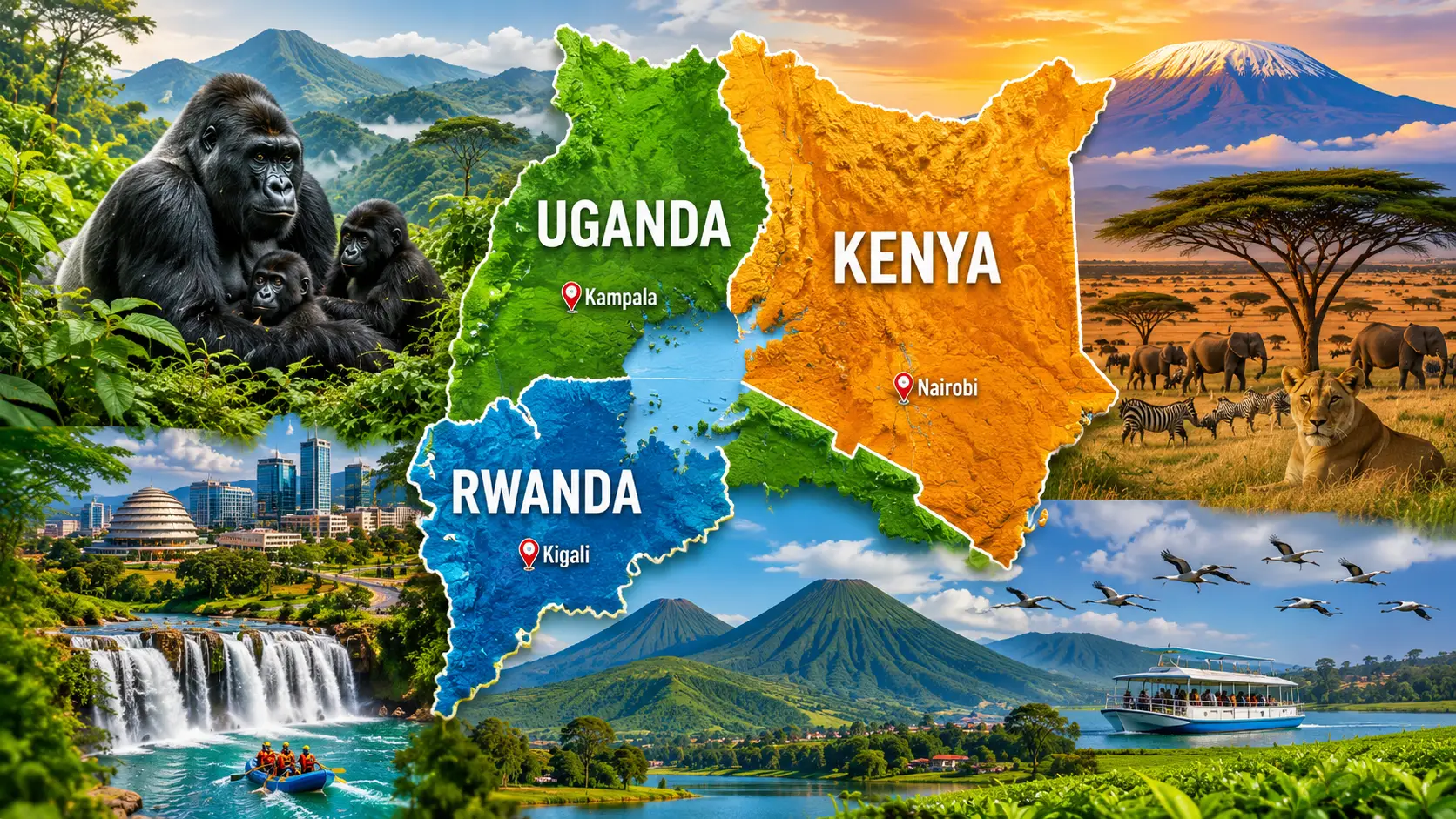
Planning a multi-country trip to East Africa just got easier. The East African Tourist Visa (EATV) allows you to visit Kenya, Uganda, and Rwanda with a single visa application and one payment of USD $100.
This EATV visa gives you 90 days of multiple-entry travel across the three countries. It’s perfect for combining a Maasai Mara safari, gorilla trekking in Bwindi or Volcanoes National Park, Lake Victoria and the River Nile experiences, in addition to seamless travel between Nairobi, Entebbe, and Kigali — without the hassle of separate visas for each country.
Despite its convenience, many travelers still have questions about the East African Tourist Visa. This complete 2026 guide covers everything: eligibility, how to apply, important rules, and common mistakes to avoid.
What Is the East African Tourist Visa?
The East African Tourist Visa (EATV) is a joint multiple-entry visa launched in 2014 by Kenya, Uganda, and Rwanda. It promotes the region as one unified tourism destination rather than three separate countries.
Before the EATV, travelers needed three separate visa applications, three payments, and three approval processes. The EATV visa simplifies everything into one document valid across Kenya, Uganda, and Rwanda.
Key Benefits:
- Unlimited cross-border movement between the three EATV countries
- 90 days total stay starting from your first entry
- Tourism-only visa (cannot be extended or renewed)
Key Facts About the East African Tourist Visa
- Countries covered by EATV: Kenya, Uganda, Rwanda
- Validity: 90 days from the date of first entry
- Entry type: Multiple entry within the three countries
- Cost: USD $100 per person (plus small card fee)
- Children: Full price applies — no discounts
- Renewable or extendable: No

Which Countries Are Included in the East African Tourist Visa?
The EATV only covers:
- Kenya
- Uganda
- Rwanda
It does not include:
- Tanzania
- Burundi
- South Sudan
- Democratic Republic of Congo (DRC)
- Ethiopia
Important Rule: Leaving the EATV zone (for example, entering Tanzania) immediately invalidates your visa. You cannot re-enter Kenya, Uganda, or Rwanda on the same East African Tourist Visa.
Planning Tip: Visit Tanzania either before or after your EATV trip to avoid complications.
Why Isn’t Tanzania Included in the EATV?
Although Tanzania belongs to the East African Community, it has not joined the East African Tourist Visa agreement. It operates its own independent eVisa system. As of mid-2026, there is no confirmed timeline for Tanzania to join.
Who Needs the East African Tourist Visa?
Most international travelers from visa-required countries (including the USA, the UK, Europe, Canada, Australia, India, and many more) should apply for the EATV if visiting more than one of the three countries.
You do not need the EATV if:
- You are an East African Community citizen (national ID is sufficient)
- You have a valid work permit in Kenya, Uganda, or Rwanda
- You are visiting only one country (a single-country tourist visa is cheaper)
Is the East African Tourist Visa Worth $100?
Yes — especially for trips spanning two or three countries.
Cost Comparison:
- Three separate visas ≈ $150
- One EATV visa = $100
You save $50 per person (or $200 for a family of four), plus significant time and paperwork.
Note: The fee is non-refundable. Only apply for the East African Tourist Visa once your itinerary is confirmed.
Golden Rule: Apply for the EATV Through Your First Entry Country
You must apply through the official portal of the country you enter first:
- Entering Uganda first → Use Uganda’s portal
- Entering Rwanda first → Use Rwanda’s portal
- Entering Kenya first → Use Kenya’s portal
Applying through the wrong portal may result in entry denial.
Official Application Portals for EATV:
- Uganda: visas.immigration.go.ug
- Rwanda: irembo.gov.rw (select V11)
- Kenya: evisa.go.ke
Apply directly — avoid third-party agents.

How to Apply for the East African Tourist Visa (Step-by-Step)
Required Documents:
- Passport valid for at least 6 months from first entry with one blank page
- Recent passport photo (white background, no glasses or caps)
- Detailed travel itinerary
- Proof of accommodation
- Return or onward ticket
- Yellow Fever vaccination certificate
Application Steps:
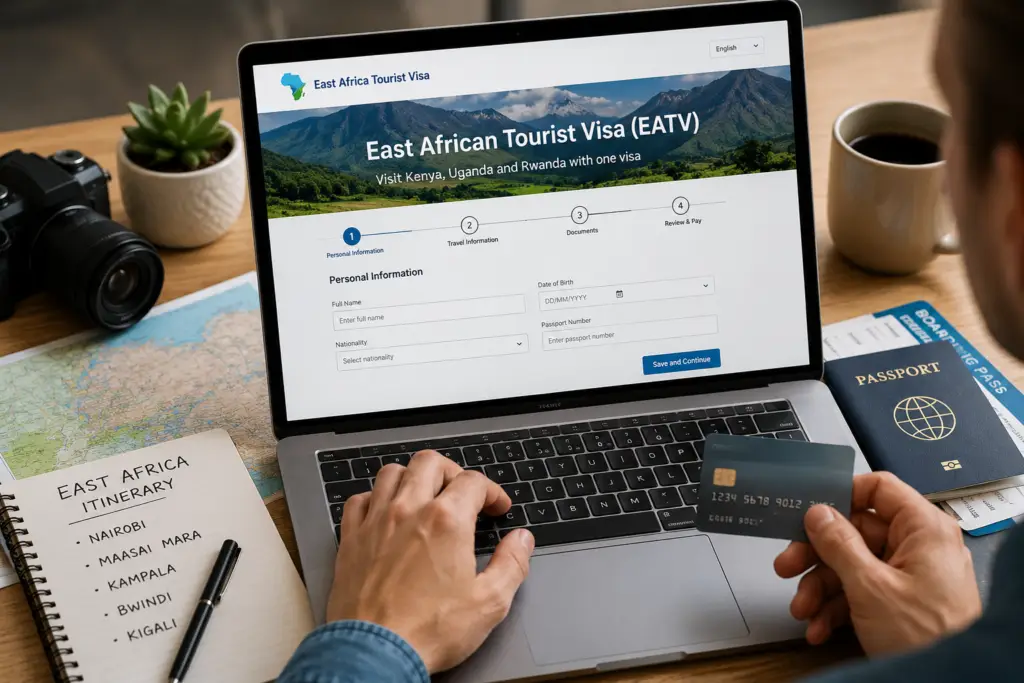
- Visit the portal of your first entry country and select East African Tourist Visa.
- Fill out the form accurately.
- Upload clear documents.
- Pay USD $100.
- Save your application reference number.
- Wait for approval (typically 3–7 business days).
Print at least three physical copies of your approval letter. At your first entry point, immigration will issue the visa sticker and start your 90-day period.
Health Requirements for the EATV
- Yellow Fever Certificate: Mandatory — original copies required at all borders.
- Malaria Prevention: Recommended in most areas. Consult your travel doctor for more information.
- Travel Insurance: Strongly advised, especially with medical evacuation cover for gorilla trekking and adventure activities.
- Check for any required digital health declaration forms.
Book Gorilla Permits Before Applying for Your EATV
Gorilla trekking is one of the top reasons travelers get the East African Tourist Visa. Permits sell out months ahead:
- Uganda (Bwindi): $800 per person
- Rwanda (Volcanoes National Park): $1,500 per person
Planning Tip: Secure your gorilla permits first, then book flights and apply for the EATV.
Common Mistakes to Avoid with the East African Tourist Visa
- Thinking Tanzania is included because it is not (this voids your EATV)
- Applying through the wrong country’s portal
- Applying too late (allow 2–3 weeks)
- Not printing physical copies of the approval letter
- Using unofficial agents
- Booking flights before gorilla permits
Pre-Travel Checklist for the East African Tourist Visa
- EATV approved via correct first-entry portal
- Approval letter printed (3+ copies)
- Valid passport and Yellow Fever certificate
- Gorilla permits confirmed
- Travel insurance with evacuation coverage
- Proof of accommodation and onward travel
- Separate Tanzania eVisa (if needed)
Crossing Borders with the East African Tourist Visa (EATV)
Once you have your East African Tourist Visa (EATV) sticker in your passport, traveling between Kenya, Uganda, and Rwanda becomes simple and seamless. However, following a few practical tips can help you avoid delays and unnecessary stress at the borders.
Mainland Border Crossings
The most commonly used land borders for EATV holders are:
- Uganda ↔ Kenya: Malaba and Busia
- Uganda ↔ Rwanda: Katuna/Gatuna and Cyanika
What to Expect at Land Borders
- Processing Time: Allow 1 to 2 hours at busy crossings for immigration checks, vehicle inspection, and passport stamping.
- Payment: Carry small denominations of US Dollars in cash. Some services at the border are cash-only, and exchange rates at the border are usually poor.
- Required Documents: Always carry printed copies of:
- Your EATV approval letter
- Hotel/accommodation bookings
- Onward travel itinerary
Tip: Digital copies on your phone are often not accepted at remote borders.
Traveling by Air Between Kenya, Uganda & Rwanda
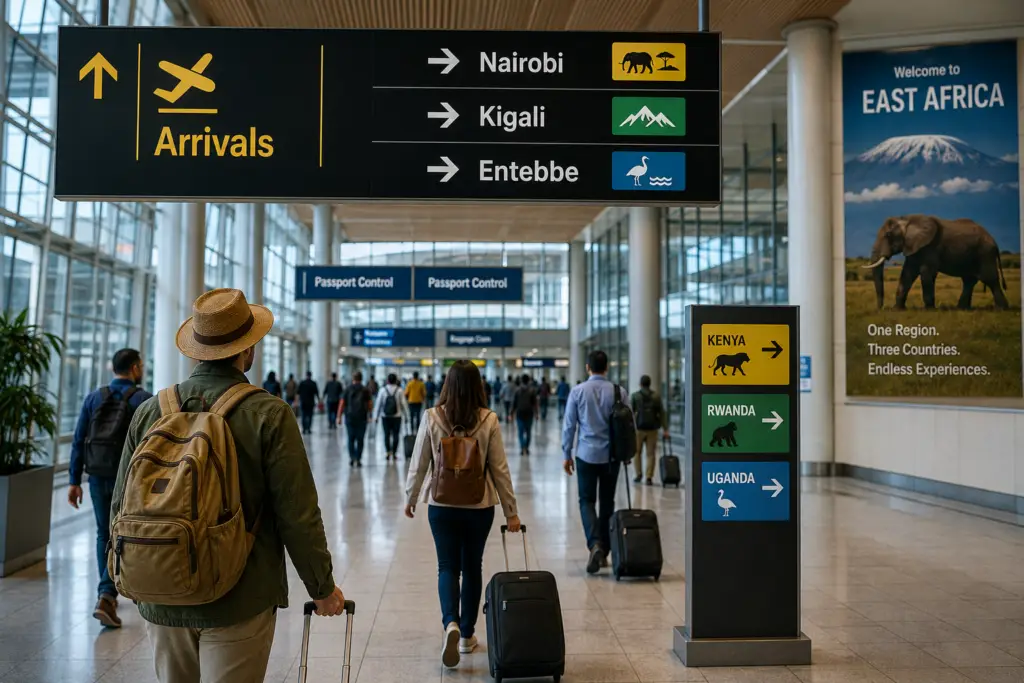
Flying between the three capitals (Nairobi, Entebbe, and Kigali) is smooth and follows standard international procedures. Major airlines operating these routes include:
- Uganda Airlines
- RwandAir
- Kenya Airways
Best Time to Apply for the East African Tourist Visa
The dry seasons, from June to September and December to February, offer the best conditions for wildlife viewing and gorilla trekking across all three countries. However, these are peak periods, meaning gorilla permits are hardest to secure, and accommodation fills quickly, so book everything well ahead.
On the other hand, the green seasons (March – May and October – November) bring quieter parks, lower prices, and better permit availability. Trekking in Bwindi during the rains is muddier and more physically demanding, but the forests are lush and the experience no less powerful. For Kenya’s Maasai Mara, the Great Wildebeest Migration peaks between July and October — if witnessing the Mara River crossings is a priority, plan your EATV trip around this window.
Frequently Asked Questions About the East African Tourist Visa
Do I need to visit all three countries?
No. You can use the EATV for two of the three. Apply through the portal of whichever one you enter first.
Does the 90-day clock start on approval or on entry?
It starts on the first entry – the moment your passport is stamped at the border.
Can I extend the EATV if I want to stay longer?
No. The EATV cannot be extended or renewed. After 90 days, you must exit the zone.
Is the EATV valid for business travel?
Uganda allows limited business activities (conferences, meetings) under the EATV, while Kenya and Rwanda do not. For any professional purpose, apply for the appropriate visa.
What if my approval email shows an error?
Contact immigration directly using your application reference number. For Rwanda: visa@migration.gov.rw. Do not travel until the issue is resolved.

